Blog
Reconnaissance trip in Kerala, Western Ghats
October, 2025

I traveled to India in October 2025, joining a study trip on human-wildlife conflict that would take me far beyond my academic routine of programming and reading papers. It was also my first time spending an extended period traveling with my professor, Tak, and I arrived feeling equal parts excitement and uncertainty about what the experience might bring.
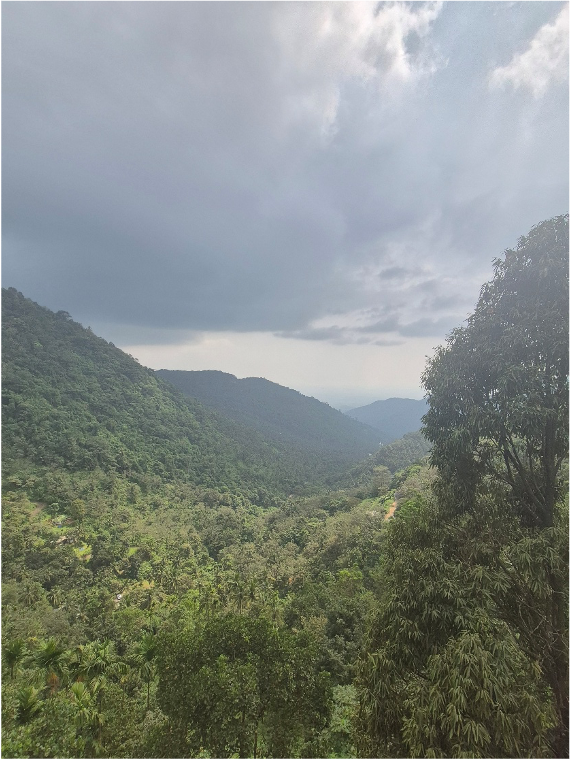
The trip was set in Wayanad, a district in northeastern Kerala along the Western Ghats. Wayanad is known both as a biodiversity hotspot and as a region marked by intense human-wildlife conflict. The situation had escalated to the point that the government declared it a national crisis. Understanding the causes, consequences, and lived realities behind this label would become one of the central goals of our visit.
After landing in Kozhikode, a central hub on the northern Kerala coastline, I met the two collaborators who would join our study trip. The first was Joseph James Erinejery, a biodiversity professor at Kannur University. Joseph and I had worked together before, including field research in Sri Lanka where we studied snakebite patterns. The second was Matthew Luskin, a professor at University of Queensland who specializes in large mammals and camera trap research.Working with such an experienced team, I knew the trip would offer a rare opportunity to view human-wildlife conflict through multiple lenses.
From Kozhikode, we continued to the biodiversity campus of Kannur University, marking our first real entry into the Western Ghats. As we climbed into the mountains, we passed an endless stretch of small villages and tea, rubber, and coffee plantations, all unfolding across the hillsides. With every turn in the road, the climate shifted, lifting us out of the dense coastal humidity and into the cool, breezy air of the mountains.
The ascent into Wayanad also became our first lesson in the remarkable forest diversity of the region. Wayanad hosts a wide range of forest types, from dense evergreen forests dominated by towering old-growth trees, to moist deciduous forests that shift dramatically with the seasons, and even dry deciduous forests that resemble open, bushy savannas. This ecological variation is a major driver of biodiversity, encouraging local speciation across microhabitats, as seen in species like the beautiful keelback snakes, while also supporting larger-scale ecological processes such as the seasonal migrations of elephants across Kerala.
When we arrived in Wayanad, we spent time with the PhD students at the biodiversity campus of Kannur University, and their enthusiasm was immediately contagious. Each conversation opened a window into a different world: one student tracked the hidden risks of zoonotic diseases carried by ticks, another explored the complex interactions between humans and monkeys, while others followed the nocturnal lives of hawkmoths and the glowing rhythms of firefly populations. It felt like stepping into a living mosaic of research, where every project revealed a new layer of connection between people, wildlife, and landscape in this intricate region of the western Ghats.
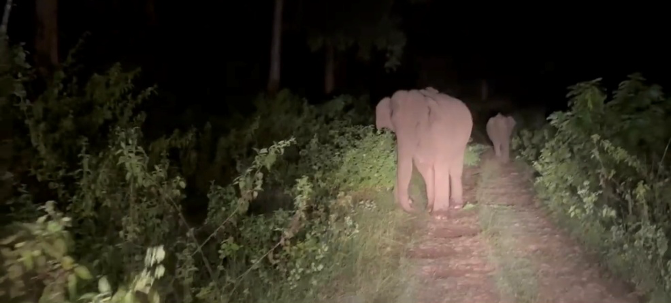
It was with these same PhD students that we had our first direct encounter with human-wildlife conflict in Wayanad. After obtaining special permission from park authorities, we set out on a night safari through an area known for its wild elephants. As evening fell, we climbed into a pair of rickety jeeps and drove slowly along the forest roads, spotting little wildlife apart from a few gaurs emerging briefly from the shadows.
We were already on our way back when we noticed two faint reflections in the dark: a mother elephant and her calf standing on the road ahead. We stopped at a distance and waited quietly for them to move. After several minutes, their shapes seemed to disappear, and we cautiously drove forward, only to realize they were still there. Suddenly, the mother charged toward us, trumpeting loudly. For a few seconds, fear and awe merged as this massive animal moved in our direction. Our driver quickly reversed, and the elephant soon returned to her calf. We drove away safely, but the encounter left a lasting impression, a powerful, firsthand glimpse into the fragile coexistence of human and wildlife.
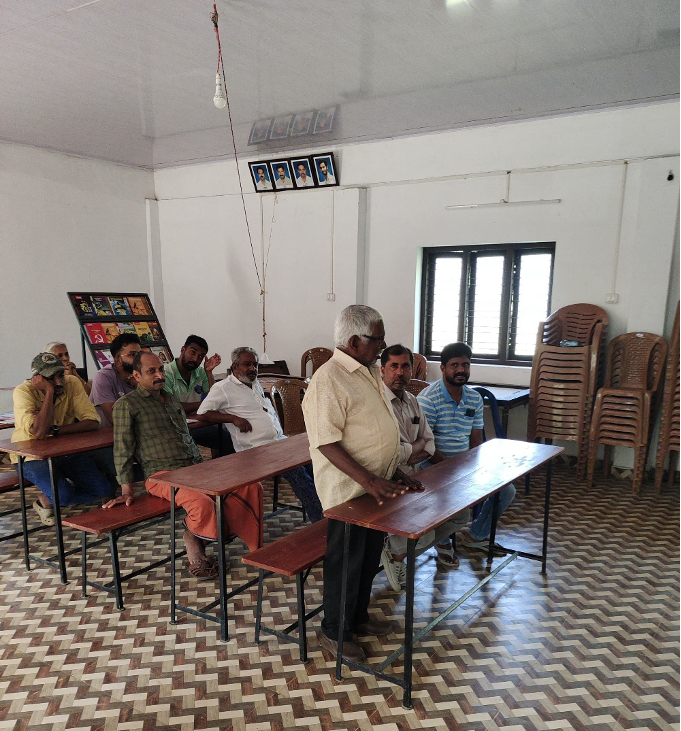
Next, we met with villagers whose lives had been deeply shaped by human-wildlife conflict in Wayanad. Inside a small community hall, we gathered with a group of older men and women, though we had originally expected to meet local youth. As the conversation unfolded, we listened to firsthand accounts from people who navigate these tensions daily. They spoke about abandoned fields, compensation schemes that felt inadequate, and their own ideas for preventing future conflicts. There was a clear sense of frustration, but also a strong desire for practical solutions. The meeting underscored how urgently communities were seeking change and highlighted the gap between policy and lived experience. For me, it reinforced why we had come to India in the first place: to help build bridges between scientific research and community knowledge in the search for more effective, grounded solutions.
The importance of community knowledge became even clearer when we met a different group of students, those from the faculty of indigenous studies. Encounters between conservation scientists and indigenous scholars are often complex, shaped by the colonial roots of many conservation practices and a legacy of mutual mistrust. This tension was palpable at the start of our meeting. The students directly challenged us, asking whether we believed conservation could ever be separated from the needs and rights of indigenous communities. It was an uncomfortable but necessary question. As they realized we shared their view that conservation must be inclusive and collaborative, the atmosphere gradually softened. What followed was a far more open and engaging dialogue, one that explored how shared goals could support both wildlife conservation and the preservation of the diverse cultures that have long shaped life across the Western Ghats.
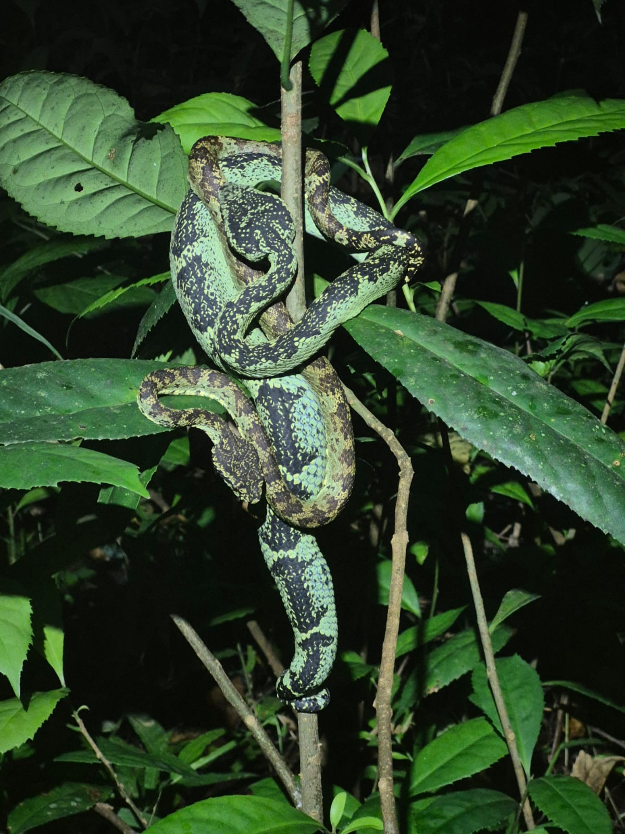
While the meetings and discussions provided essential context for understanding conservation challenges, it was during a night herping excursion that I felt most directly connected to the biodiversity we had been discussing. That evening would become the personal highlight of my visit to Wayanad. With a local guide, we entered the jungle after dark, our flashlights sweeping across leaves and branches. We spotted several frogs, delicate vine snakes, and what felt like an endless stream of leeches. Still, I had one specific hope: to find the Malabar pit viper, an arboreal snake so well camouflaged that it often goes unnoticed, despite its striking green and brown patterns. As time passed without a sighting, I joked that we would not leave until we found one. Then, just as we were about to head back, our guide suddenly stopped and pointed to a nearby branch inside of the thicket. There, nearly invisible against the jungle background, was a pair of Malabar pit vipers mating, a rare and mesmerizing moment that made the entire night unforgettable.
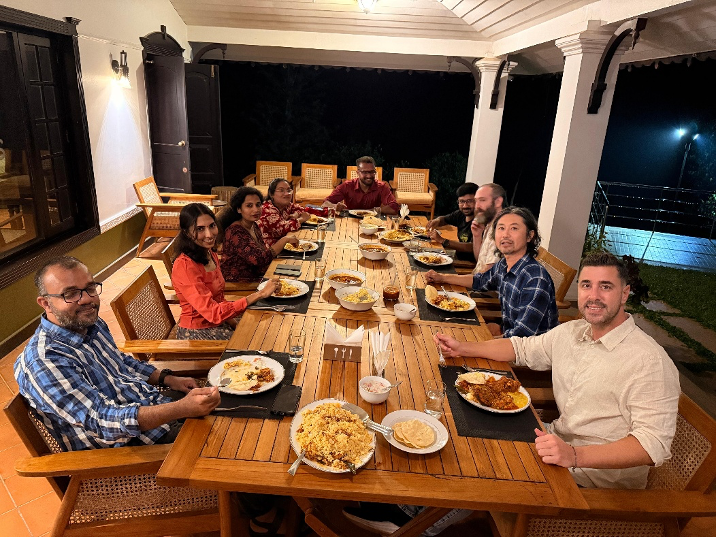
Our final evening together was marked by a shared dinner, filled with the kind of conversations that only come after days of intense field experiences. It was both a goodbye and a beginning, as we reflected on what we had learned and imagined the collaborations that might grow from it. Even now, just months later, I often catch myself thinking back to Wayanad and feeling a strong pull to return, to continue the work and deepen the connections we began there.


